
Fluid Air and its parent, Spraying Systems Co., have extensive capabilities in building processing equipment for mixing, coating, and PolarDry® electrostatic drying. Our advanced laboratories and pilot facilities help accelerate your development and scale up process from bench scale to pilot scale and full production.
Get to market faster, utilizing design and process engineering experts and pilot facilities.
Common Challenges
Proof of Concept Testing and Evaluation
Working to validate or refine a material or mix? Our labs provide us with the ability to test and prove processes. This can bring you greater success, months faster and with less risk.
Develop a Production Scale-up Process from Lab to Pilot
Ready to move from bench-scale processing to pilot production? Using the right equipment and tapping our expertise can help you achieve a successful pilot production process.
Develop and Build a Production Process
Time to produce in quantity? We can help you develop a business case for your innovation and help you equip and set up full-scale production at your plant.
We help customers test and refine active materials’ morphology and provide the equipment and engineering support needed for scalable production from grams to tons.
Our PolarDry® electrostatic drying enables continuous, faster drying at moderate temperatures with high yields. PolarDry outperforms conventional spray drying on purity, particle characteristics, and yield. It’s a single-step process. It combines the principles of conventional spray drying with electrostatic forces to enhance particle control and coating uniformity.
In electrostatic drying, a solution or suspension is atomized into fine droplets using a specialized two-fluid nozzle that imparts a charge to the droplets as they are formed, which improves drying efficiency and can improve coating uniformity, enable lower processing temperatures, and control morphologies.
Unlike conventional spray drying, which relies solely on thermal evaporation, electrostatic drying provides several unique advantages for nanomaterial processing:
- Improved coating uniformity
- Lower processing temperatures
- Controlled morphologies
Electrostatic drying can mitigate issues often associated with advanced materials, such as interfacial instability, mechanical degradation, and phase inhomogeneity, that frequently limit the commercial viability of high-capacity materials.
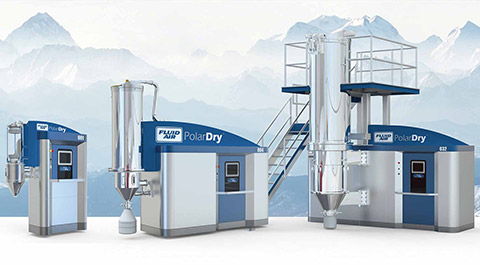
PolarDry® Electrostatic Drying
- Rapid prototyping
- Active material surface coating
- Experienced engineering support
- Faster processing to match supply with demand

Fluid Air High-Shear Coating
Whether you need wet or dry coating and blending technology for R&D, pilot or production-scaled applications, Fluid Air can help.
